

Understand how walking robots move
Pupils learn how coordinated leg movement and body balance allow a multi-legged robot to walk and change direction.





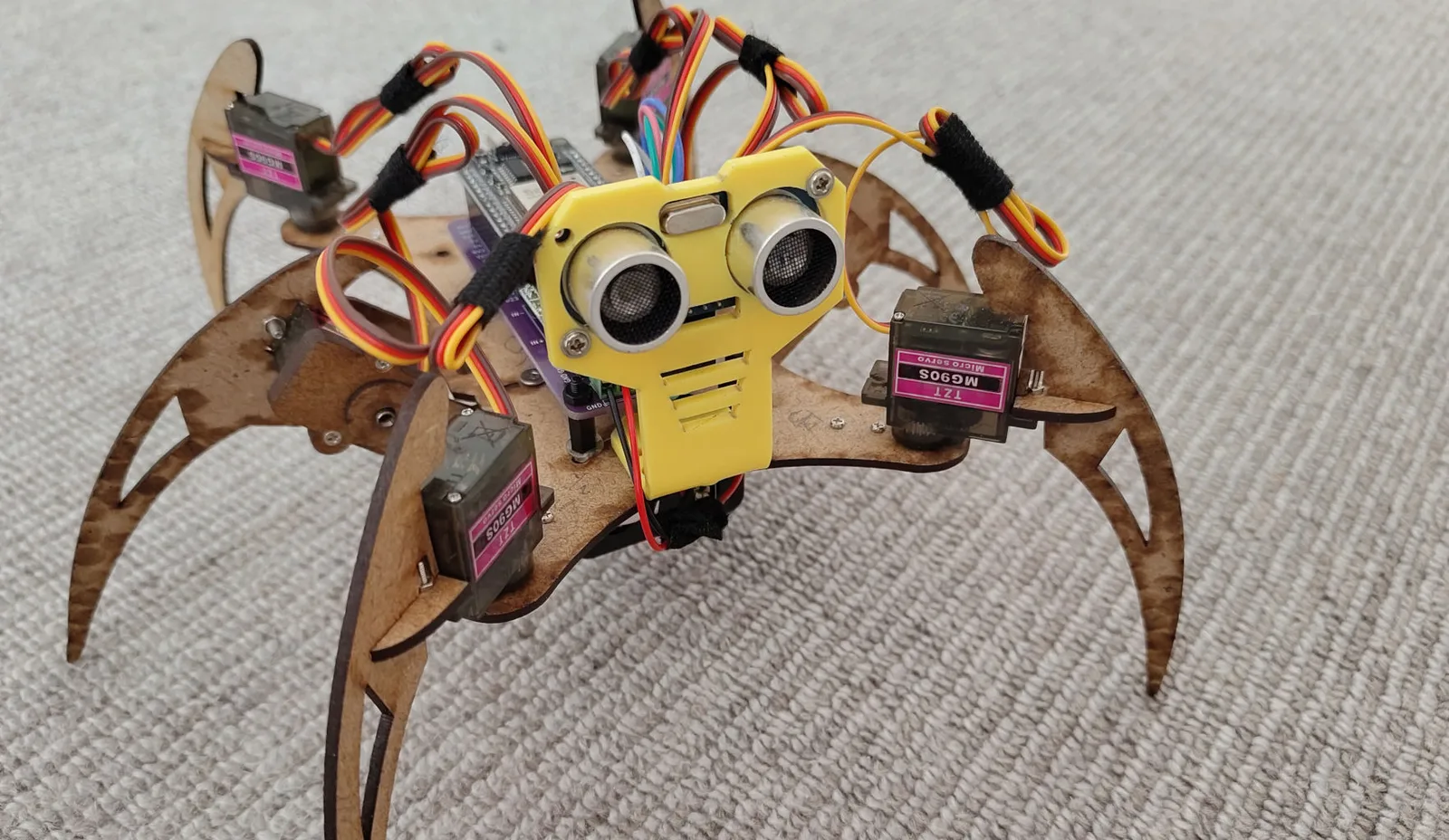
Pupils learn how coordinated leg movement and body balance allow a multi-legged robot to walk and change direction.

Pupils discover how servo motors can control accurate angular movement and how multiple servos work together in a robotic mechanism.

Pupils connect servo motors, an ultrasonic sensor, a microcontroller, power regulation modules, and batteries using a structured wiring diagram.
Pupils use an ultrasonic distance sensor to detect nearby objects and create simple autonomous behaviours based on sensor input.
Using a block-based programming environment, pupils create movement sequences that coordinate multiple motors to generate stable walking motion.
Pupils experiment with delays, movement speed, and motion sequences to improve the robot’s balance and walking performance.
Pupils see how software instructions are translated into physical movement through electronic signals and motor control.
Pupils test, debug, and refine their robots by adjusting wiring, mechanical alignment, movement timing, and sensor behaviour.
By building and programming their own walking robot, pupils experience how electronics, mechanics, sensors, and software combine to create an autonomous robotic system.
That is a take-home project!
5 days, from 20 Jul'26 - 24 Jul’26
Age: from 8 years old (to 11)
All equipment, laptops, robots and educational materials are provided by us.

We’ve received your Trial booking request.
Here’s what happens next:
 The closest parking at the Old Deer Park (Extension)