

Understand how walking robots generate movement
Pupils learn how coordinated servo motion and body balance create stable walking behaviour in a multi-legged robot.





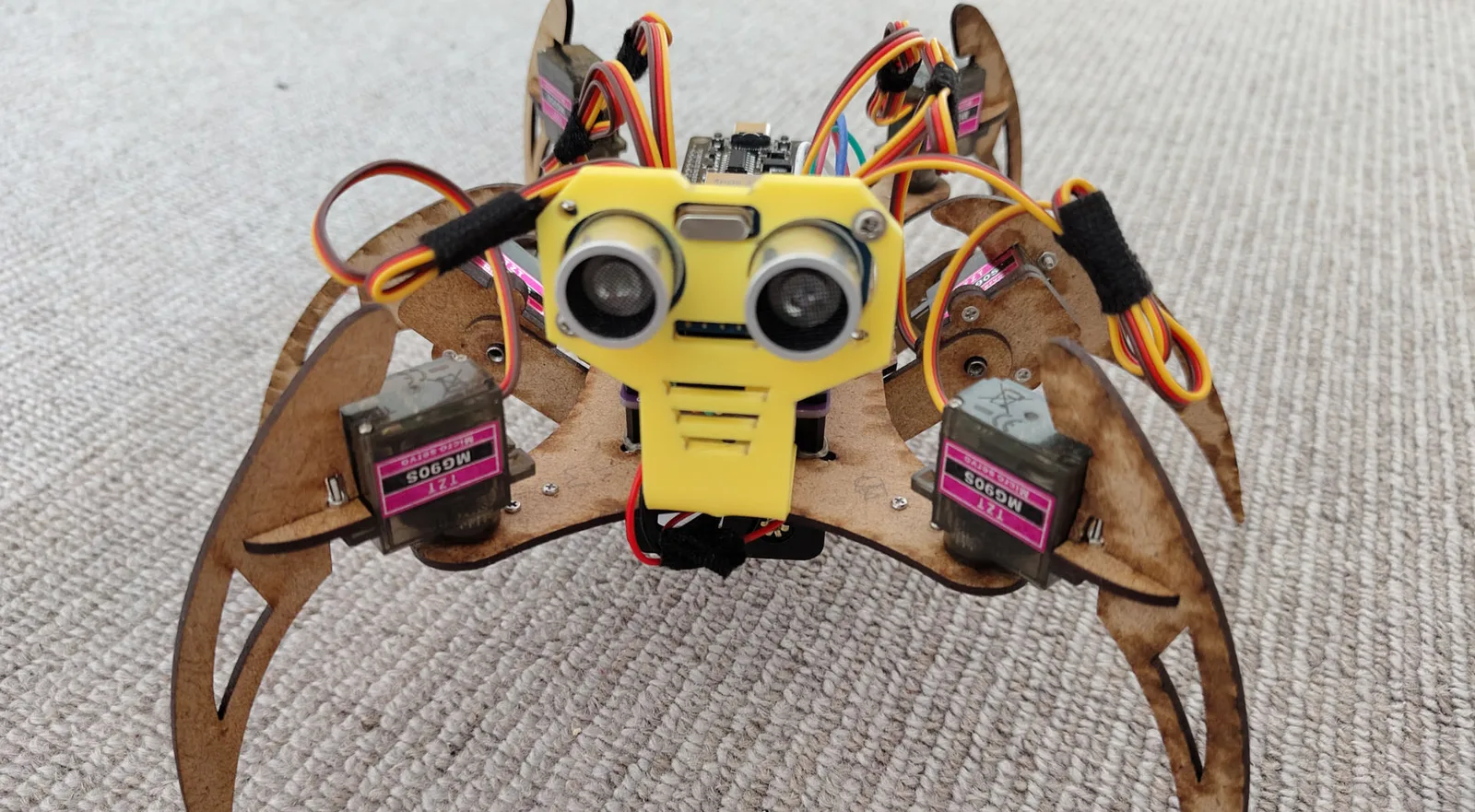
Pupils learn how coordinated servo motion and body balance create stable walking behaviour in a multi-legged robot.

Pupils explore how PWM signals and timed position updates allow servo motors to produce accurate mechanical movement.

Pupils connect servo motors, sensors, power systems, and a microcontroller using real electronic schematics and wiring diagrams.
Pupils write and modify real embedded C code using variables, functions, loops, timing logic, and sensor input handling.
Pupils learn how movement timing, weight transfer, and coordinated motor control affect robot stability and walking performance.
Using an ultrasonic distance sensor, pupils create programs that allow the robot to react automatically to nearby objects and user interaction.
Pupils see how code running on a microcontroller directly controls motors, sensors, and mechanical movement in a real robot.
Pupils test their robots, diagnose movement and wiring issues, and refine both software and mechanical setup through experimentation.
By building and programming a complete walking robot, pupils gain hands-on experience with electronics, mechanics, sensors, power systems, and real-time embedded programming.
That is a take-home project!
5 days, from 20 Jul'26 - 24 Jul’26
Start at 12.30 until 15.30
Age: from 11 years old (to 17)
All equipment, laptops, robots and educational materials are provided by us.

We’ve received your Trial booking request.
Here’s what happens next:
 The closest parking at the Old Deer Park (Extension)